Jólakötturinn – Iceland’s Big, Bad Kitty
Ever looked at your cat on a dark, cold winter’s night and contemplated Ice Age felines? The kind who wanted to consume, not cuddle us? I think that comes with domestic cat parenting! They all have moments where you catch a glimpse of an apex predator.
Well, meet their cousin in spirit: Jólakötturinn, the Icelandic Yule Cat. A mix of folklore, moral tale, and winter metaphor, it has prowled Icelandic winters for at least 150 years. If you love cats and prefer your holiday folklore less commercial, settle in; we’re getting to know the Yule Cat!
About that name…
Icelandic name: Jólakötturinn — literal: Yule / Christmas cat.
Approximate: YO-lah-KUH-tur-rin (stress on the first syllable).
Click for IPA reference and native audio (Wiktionary).
Literary appearance of the Yule Cat
The earliest definitive printed reference to the Yule Cat comes from Jón Árnason’s 1862 collection Íslenzkar þjóðsögur og æfintýri. (Say that, my fellow Americans, I dare you!)
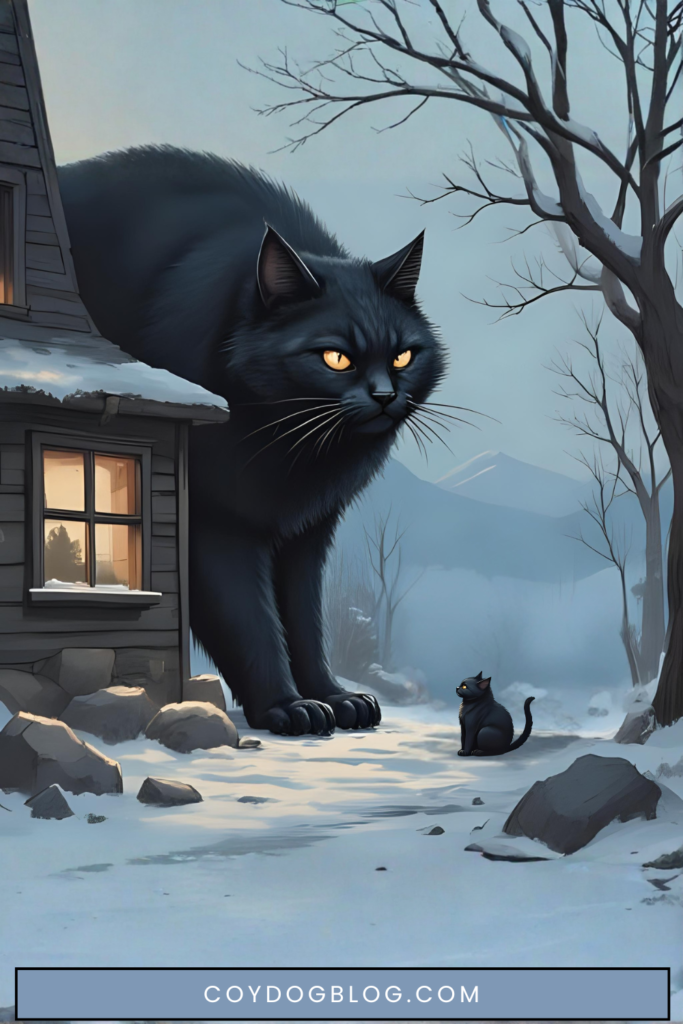
However, the story was almost certainly older, existing in oral retellings long before being written down. This is the case with many legends, myths, and folktales. By the 20th century, the Yule Cat had developed into the form familiar in its native country today: a monstrous black cat that just might devour you!
It’s also worth noting that the cat is part of a wider circle of seasonal characters. Notably, Gryla, best described as an ogress, and the offspring of her first marriage, the Yule Lads. Though the Yule Lads, like the rest of the folklore, have been toned down considerably to fit modern times, they’re still creepy! Not that Gryla isn’t, but there’s something about small, child-like beings with often outrageous features sneaking into your home to trick and steal that’s particularly creepy in my opinion. (Then again, I’ve had some really awful neighbor kids in the past. It could just be personal!)
Regardless, the Yule Cat is sometimes said to be owned by Gryla and/or the Yule Lads. I’ve even found references to the cat being ridden like a horse at times! Sadly, I could find no old artwork of this, but the imagery was funny. Really, imagine your cat being the size of a house and allowing you to ride on them like that! At least it could be said for this creepy family that they must have an extremely good relationship of trust and affection developed with their cat – they definitely didn’t use a squirt bottle.
Unfortunately, that’s not how this cat decides who it’ll eat. This tale gets wilder!


The cat and the clothes – this is where it gets weirder
Well, it gets weirder on the surface, anyway.
If an enormous cat appearing from the wilderness to creep on people during the Yule season, potentially to hunt them like mice, wasn’t fascinatingly odd enough, the reason for doing so is. Perhaps the most memorable bit of the tale (yes, more so than the cat itself) is the “rule” that if you don’t receive a new piece of clothing before the start of Yule, you’re in danger from the Jólakötturinn.
Yes, you read that correctly! Getting eaten by the Yule Cat could come down to whether you receive a single sock before the cat’s seasonal arrival.
Though today, in accordance with gentler times and treatment of children, the Jólakötturinn could simply deprive you of your Christmas treat. Not as bad as being eaten!
Though kittens and cats are known to enjoy suckling on wool (they like the texture, warmth, and lanolin), and woolen clothing factors into the myth, that’s not why the Yule Cat has this memorable standard for victims.
It was a social incentive.
The reason harkens back to the folklore’s origin in more agrarian times, when farming communities were the majority. In those farming communities, finishing autumn woolwork meant people got new clothes; those who didn’t finish the work got nothing. Stories of the Yule Cat were used to encourage productivity and to emphasize the stakes of being unprepared for winter.
Turning sheared wool into yarn and yarn into clothing, all by hand, was a lot of work. Assuredly, this could become physically and mentally tiring in short order, especially as the world grew darker, stayed that way longer, and became generally inhospitable with extreme cold and stricter, limited food supplies. I don’t know about you, but I don’t want to do anything except a good imitation of hibernation when it’s cold – imagine Iceland in the winter!
But not finishing woolwork meant wasted wool, no yarn, and no new woolen clothing. Not just for yourself, but also for your family, community, and to sell. Thus, reminding and shoring up that reality during bleak times by way of the Yule Cat’s punishment – social incentive.
Additionally, being unprepared in winter today in less extreme climates can be a dangerous prospect. Over a century ago, at minimum, lack of preparedness during an Icelandic winter was outright deadly. The winter environment could easily steal you away, like the Yule Cat in the cold darkness, without adequate awareness and appropriate clothing. Wool, as it just so happens, is an optimal material for such harsh winter environs!
Lastly, as the structure of society changed with industrialization, the folklore took on another element of social incentive: efficient and rewarded employees.
No one likes either a lazy worker or an unappreciative boss! The importance of finishing critical tasks like woolwork remained the same, only morphing into the more modern structure of working in factories, for a company, and so on. As we all know, that structure can result in high pressure, high expectation, but low reward situations for workers. Keeping the folklore alive in cultural relevance could evolve into the expectation that workers were rewarded for their hard work. In that era, a “Christmas bonus” of necessary, certainly not cheap, items like shoes and clothing, or other items workers produced, was common.
Do you want to be the Boss or business owner responsible for your employees being, metaphorically or otherwise, eaten by a giant monster cat because you couldn’t give hard workers a pair of new socks? Nope! Even if you skew toward Scrouge as a boss, the answer is still “no,” as your community wouldn’t look favorably on that!


Pagan roots, seasonal symbolism, and resonance
Though the Yule Cat as known today appears in printed sources in the 19th–20th centuries, the story is wrapped in older themes.
Boundary-crossing winter monsters, household familiars, and agrarian calendars are all part of why the cat resonates. These are cultural elements, and agrarian calendars harken back to the majority of our time as a species. Agrarian societies began 10,000 to 12,000 years ago, while the industrial age began about 1760. That’s around a mere 265 years! Humans followed a seasonal schedule much longer!
In marking seasons, what needed to transpire during them, and in observing the cyclical nature of the world, we created celebrations, figures, and stories to accompany them. The cycle of life, death/dormancy, and rebirth has been with us for a very long time. No wonder that folklore like the Yule Cat, which connects with both specific cultures and millennia of human existence, resonates then and now!
As a Pagan-seasonal figure, the Yule Cat fits neatly into the larger pattern of Yule customs that center on the darkest time of year. The longest night, an emphasis on provisioning, and community care. Sensibly, especially so far north! The entire world must have seemed reduced to a fine point of all things inhospitable; the darkest days were also the coldest. A time when being prepared, relying on provisions, and communal awareness meant surviving…or not.
In our modern world with heating, electric lights, first responders, entertainment, grocery stores, vehicles, and ever-present phones to summon help and items, that’s become unthinkable for most. The natural fear of the unfamiliar and the perils that lurk in the darkness mean the spooky, grim aspects of this myth are sure to keep resonating!
Still, we’d be remiss if we relegated the Yule Cat to a pointless bit of terror! The lessons of this folklore remain true, even in our comparatively cushy modern lives.
The Yule Cat reminds us to be prepared for the harshest times, both practically -clothing, food, shelter, the necessities- and socially -sharing resources and burdens, checking on and helping neighbors.
All very good things to remember…just dressed as a monster-sized cat that might be out hunting humans!
Reality & Today
Real cats and predators of Iceland
Real cats arrived in Iceland with its early settlers — Vikings. We can thank the Vikings for spreading cats across Europe and beyond. Cats were brought on ships for rodent control, which was probably obvious -a seafaring society would need to resolve that issue!
However, cats were also significant in Viking culture as companion animals and in their affiliation with the goddess Freyja. Yes, this scary warrior culture loved cats! (Remember that next time someone clings to the bizarre notion that feline friends are for soft Victorian-style ladies!)
Cats were often significant wedding gifts, symbolizing luck and prosperity in marriage; they were given to new brides. This was due to their strong association with Freyja.
As Vikings not only traveled to new areas but also began to establish settlements, their cats came along. In addition to being the foundation for breeds like the Norwegian Forest Cat, genetic evidence suggests they influenced global cat genetics by taking and spreading cats from places like the Middle East and Egypt. There is even evidence that orange and calico cats were reintroduced thanks to the Vikings. (Having an orange cat in my life, that tracks.)
So, of course, they introduced domestic cats to Iceland. Cats have been present in Icelandic life for centuries now. Today, they’re common and beloved pets…as they should be!
If they’re a common pet, just like nearly everywhere else, why is the Yule Cat, well, a cat? Why not pick a terrifying wild predator for this role?
There aren’t any! Iceland has a sparse natural predator scene. (On land, anyway.) The arctic fox is the only native land predator. If you were thinking polar bears due to the environment, they’re extremely rare visitors. They don’t naturally reside there, just very rarely arrive on ice floes from Greenland. Once there, Iceland isn’t exactly hospitable for these huge bears, either. So, the cute little arctic fox continues to be the unlikely terrestrial predator king!
This lack of large predators and familiarity with domestic cats’ hunting prowess likely gave rise to the Yule Cat as a cat. Undoubtedly, lacking the threat of bears, wolves, or large wild cats made the imagery of a giant, human-eating cat particularly striking to Icelanders.
If you’d like to know more about the “Viking Cat Distribution System,” as I call it, check out this article in Scientific American: How Cats Conquered the World (and a few Viking Ships)
Iceland’s Yule Cat today
Thankfully, this unique character hasn’t been forgotten, but rather, continues to be embraced. In a time where so much regional, cultural folklore has been erased, forgotten, or has drastically faded, we wish more places would take a note from Iceland!
By the mid-20th century, the Yule Cat had become a recognizable piece of Icelandic holiday folklore. The cat is part of a suite with Gryla (the troll-like ogress) and the mischievous Yule Lads. On the internet, Gryla and the Yule Lads might have cause to worry about the Yule Cat eclipsing them, but then, the internet does love cats!
In Iceland today, the Yule Cat appears in stories, decorations, and in local writing and museum displays. Obviously, modern-day Icelanders generally treat it as folklore: a spooky, humorous, and culturally rooted story rather than a literal threat.
The Yule Cat is an appealing seasonal mascot for locals and tourists alike who appreciate the island’s mix of stark natural danger and warm community rituals.
History, culture, folklore, environment – all these things and more make Iceland one of those especially unique places. Though the Yule Cat would fascinate me anyway, as a cat, creepiness, and history lover, this seasonal feline’s ability to encapsulate the vibe of such a unique place wowed me further.
What a beautiful way to both continue and share the folklore, culture, and unique island itself in modern times!


Lessons from the Icelandic Yule Cat
In closing this post introducing you to the Jólakötturinn, I realize there were a lot of facts and history -about cats, agrarian existence, Vikings…it was a very educational post, okay!
Lest the teachings of the folklore slide by the wayside, let’s revisit those –and a bonus bit about how you can apply those teachings to pets! + Yule Cat Gallery, featuring a series with housecats!
Yule Cat Lessons – the teachings in the folklore.
- Prepare. A concrete and practical lesson: finish the seasonal work, and most certainly, be prepared for and during this coldest, darkest part of winter.
- Community reciprocity. As in the work-reward tradition, those who contributed were sheltered by the community’s bounty. Sharing the work allows for better ensuring and sharing the fruits of that labor; if we’re all on the same page and contributing as we’re able, our community can handle larger tasks and worse seasons (literally and metaphorically).
- Respect the season. Metaphorically, the monster cat represents the harsh and easily deadly winter season. It reminds communities to gather and help one another through the dark, cold months, as well as individuals to be literally prepared to handle the unique dangers of winter that seem to lie in wait.
These lessons are good, practical ones -and timeless, at that!
Preparation, respectful understanding of seasons, and being true communities with reciprocity and support are all as old as humans successfully surviving together for thousands of years. These are also things that continue to serve our communities today. Including our pets!
I hope you enjoyed meeting the Yule Cat and will remember the teachings of this particular feline folklore. Don’t forget to check out how you can apply Yule Cat teachings to pets below!
Yule Cat Lessons – Applied to Pets!
Here are some ideas on how you can apply the teachings of the Yule Cat folklore to pets – your own and those in your community!
Prepare…
Plan enrichment activities to prevent boredom, frustration, and lack of exercise on those short winter days. Winter changes things for most pets, and those changes have little about them that’s welcome.
They might love the upside of you being home and indoors with them more often (though, you should take care that your pet is still getting legitimate rest during your increased home time, and transition slowly into being away more again), but lying about languidly isn’t the luxury lifestyle for pets that humans feel it is. Yes, even cats! They might sleep a remarkable 70% of their lives in short snoozing sessions, but in between, they need and want to exercise their minds and bodies.
For cats with catios, who go on leashed walks, on hiking and camping trips, stroller walks, or otherwise have safe access to the outdoors, the issue is obvious -it’s too cold, possibly even wet, out. Though some cats might determinedly venture out anyway, remember that they’re like human children; they don’t always know what’s best for themselves and make poor choices. You might be required to close off points of free access, and I think we all know how well that’ll go over.
For dogs, pets we’re more accustomed to venturing out of the house with, it’s the same obvious issue. Even if they enjoy the weather, we have to limit it, and many of us humans neither like nor tolerate the cold well. (Me!) Their lifestyle and the scope of the world itself drastically change, and like cats, we tend to expect them to not change in response.
Even for pets without access to the outdoors, with or without a guardian, the changes of the season can cause boredom and stress. Less people, wildlife, and other activity to watch from the windows. More activity and noise in the home. The natural reaction to increasingly long nights.
Planning enrichment activities can help immensely in preventing boredom, keeping your pet more active, and allowing for stress relief!
You don’t even need to buy enrichment toys; paper towel rolls, cardboard boxes, empty water bottles, muffin tins, towels -you have loads of supplies right in your warm, cozy home already!
As many enrichment games involve treats, be sure you’re taking a little bit off their food, or using their daily food amount as part of the activity.
You just need a little creativity! If you need help dreaming up ideas, a quick search for “DIY cat enrichment,” for example, will give you a jumpstart.
Remember: ideal enrichment engages your pet’s natural instincts and individual inclinations to fulfill those needs. For cats and dogs, engaging their inner predator is always a good bet -they all have individual preferences on what activates this, so pay attention to your pet’s play styles! You want to be exercising your pet’s mind and senses. Consider sounds and smells, and build up their ability to “forage” or problem solve. Exercising the mind, especially when hitting on natural instincts and their “superpowers” of scent and hearing, is more effective than strictly physical exercise. Don’t forget your pet’s mind and all their amazing senses!
Communal Reciprocity
Pets in your community might not be finishing critical woolwork or otherwise holding down jobs that contribute, but they are part of your community. Properly cared for pets contribute in other ways, too.
They bring many benefits to their guardians, and can enrich the lives of those around them in the neighborhood just by getting to pet them or watch their antics in the neighboring yard. Additionally, healthy, safe, loved pets contribute by…well, what they’re not contributing. When pets are cared for like the domestic companion animals they are, they’re not disturbing the peace, destroying property, spreading parasites or diseases, depleting strapped resources, or presenting the danger of attacks on other animals and human community members.
Caring for pets in the community isn’t just ethical or something that tugs the heartstrings; it’s a sort of community reciprocity! Relationships are work, living “in a society” is work, and the same is true of your community. If we all assume a vested interest in improving the lives of pets in our communities, that, in turn, improves everyone’s lives in the community. Worthwhile effort with a reward we can all feel!
There are many ways to improve the lives of pets in your community, though they’ll depend on what problems exist in your little corner of the world. It might be taking some time during your holiday days off to research and get something started to change things like: local laws regarding tethering dogs and “outside” pets, lacking areas of the effective multifaceted approach to pet overpopulation, or even starting a group online where like-minded pet lovers can discuss and tackle community problems.
One great thing to do during this time of many sales and getting winter items out of closets and totes is to donate much-needed supplies. Rescues and animal shelters always need “boring” supplies like paper towels, pet-safe cleansers, laundry supplies, and pet-specific disinfectants. They also always need blankets and towels!
I can personally attest to how quickly all of the above are gone through or destroyed in rescues, shelters, low-cost pet clinics, and anything that involves a number of pets being cared for. A bottle of Dawn dish soap for bowl washing, a pack of laundry detergent, or your old (but still safely viable!) or excess towels and throw blankets are actually a huge deal!
And, of course, opening your home or providing a service! If you can, responsibly and safely, foster an appropriate pet for your household, that is major. Fostering gets pets into a more normal and comfortable home setting. This can make a huge difference in preparing them for success in their forever homes; the pet doesn’t have as much built up stress when adopted, can work on important life skills, give a far more accurate picture of their personality and needs for potential adopters, and it lets kittens and puppies develop into more successful adults, as well as providing “golden years” comfort for seniors.
If you’re in the grooming or veterinary field, or are a legitimate trainer, giving some of your services to pets in need is another big help for pets in the community! Help pets stay clean, healthy, and looking their best while waiting on a home, or give a nail trim to a pet whose guardian is unable and on a low, fixed income. Volunteer time at a low-cost or free pet clinic; help alter, assess, vaccinate, microchip, or treat pets in need. Help pets stay in good homes or prepare for their new homes by offering your expertise in pet behavior and teaching.
Respecting the Season
Knowing and respecting the season is part of both preparation and being an involved community member. When you know what winter will bring, you can help others be prepared to weather it.
Considering the unique dangers of the season and gathering together to survive through communal efforts and preparations brings to my mind the tragic issue of stray and feral cats. There are loads of horrible problems facing the canine community, but it remains appalling that in this century, so many people continue viewing cats as at least semi-wild animals.
Cats, the common housecat, are fully, legitimately domesticated. Felis domesticus = housecats, the only member of the genus Felis that can be domesticated. They might seem to hold more of the trappings of the wild than dogs, but they’re no more a natural, wild species than domestic dogs. This real distinction in their very genes means that even the most feral of stray cats is not equipped to handle life without human intervention for long. (It’s also why, if you put in the work and patience, ferals are not lost causes as pets!)
Whether they’re colony or “community” cats or strays with nowhere to go in the current world of shelters, rescues, and pet homes being overburdened, these cats need help.
A simple way to help them through the winter is by giving them some actual shelter!
If you have the money and an appropriate area, there is now a variety of heated houses designed just for outdoor cats. Find them on Amazon, Chewy, Petco, and Petsmart online, and In person, check out “home and ranch” or feed style stores like Atwood’s and Tractor Supply Company, or (always!) call small local businesses.
I bought this one for our less than cared for neighbor cats and passing strays. Since I’ve not reviewed it yet, let me just say that I recommend maybe going for a bigger size or multi-level style; the cats near me have been a bit bothered by the protective overhang and door flaps. I needed to feed them near it, and place catnip and treats inside to encourage them to explore inside.
Houses are easy and cheap to make If you want to DIY! For years, I’ve had at least one such DIY house for strays/ferals/less cared for pet cats around me…they love it!
Simply take a large styrofoam ice chest, cut a door opening, lift the top and fill with straw, put the top back on, and place it where the cats visit. You have a warm, dry place for outside cats at a very low cost and even lower level of effort!
I strongly recommend getting a plastic storage tote slightly larger than the styrofoam cooler/ice chest; place the ice chest inside, cut a door that aligns with the ice chest door. This makes your DIY house even better!
If doing a DIY house…
- You’ll need a styrofoam ice chest that’s large enough for a lot of straw and a cat, but not too large. Too large, and it will lose heat. Something to cut a small door hole in styrofoam and potentially plastic. Dry, clean straw. Optimally, a plastic tote slightly larger than the ice chest to put the ice chest into.
- STRAW! Always use straw, not blankets, towels, or pet beds. This might seem counterintuitive and uncomfortable, but straw keeps maximum warmth without becoming moist. Towels, blankets, etc. all can sap body heat outdoors in the cold! Additionally, cats actually like the straw quite a bit!
- Fill the cooler very full with the straw. You can reach in the doorway to make a little entrance, but you need a high volume of straw for it to work. The cats will make their own cozy tunnel-beds.
- Cut the door opening large enough for a cat to enter, but no larger! Small openings=less warm air escaping and cold air entering. This can also make cats feel safer and keep out larger predators like loose dogs.
- Placement matters! Use an area the cats visit and feel reasonably secure in. Make sure the door opening is NOT facing North. (If you add a second escape hatch sort of hole on a really big ice chest, ensure it’s not facing North as well.) Place where cats can be as safe as possible, not just from the elements, but from wildlife, loose and stray dogs, and people.
- DO NOT place electric heating beds or heating pads in the cooler!
- If possible, place where you can monitor on a camera.
- Preferably, do not place food in the house, this can just attract raccoons, who don’t really want to share their new warm house.
- If necessary to encourage use, sprinkle catnip inside and/or leave cat treats outside the door, with a few just inside the door.
- Remember that cats are prey as well as predators! It might take them a few days to feel comfortable going inside; set up the house several days in advance of cold or severe weather if possible.
- Styrofoam is excellent at holding temperature and easy to cut, but it’s also lightweight. Make sure the house, including lid, are secured from wind.
- FOR MAXIMUM WARMTH: place the styrofoam ice chest stuffed with straw inside of a larger plastic storage tote. If there is space between the styrofoam chest and plastic tote, stuff straw into those spaces for extra insulation. Cut aligning door holes in each container.
Lastly, don’t forget about water in the winter! In spring and summer, we tend to be more aware that wildlife and loose, stray, or feral cats might be thirsty. Water can be very hard to find in winter, and might be needed more than the food you’ve put out. Help birds and wildlife in the community this season by using bird bath-sized warmers to keep water from freezing. For cats, use a pet bowl (usually designed for large dogs) with a plug-in heating element to keep unfrozen, fresh water available. Never use tall, deep containers like buckets that smaller wildlife and cats could fall into and be unable to get out of!
Preparedness and communal awareness in all seasons are things we should keep in mind! Starting with this winter season, though, there are nearly endless things you can do keep your pets and those in your community enriched, comfortable, and safe. Remember the teachings of the Yule Cat folklore, you might be surprised what you’ll notice and can improve when you do!
Extra Yule Cats to Enjoy!
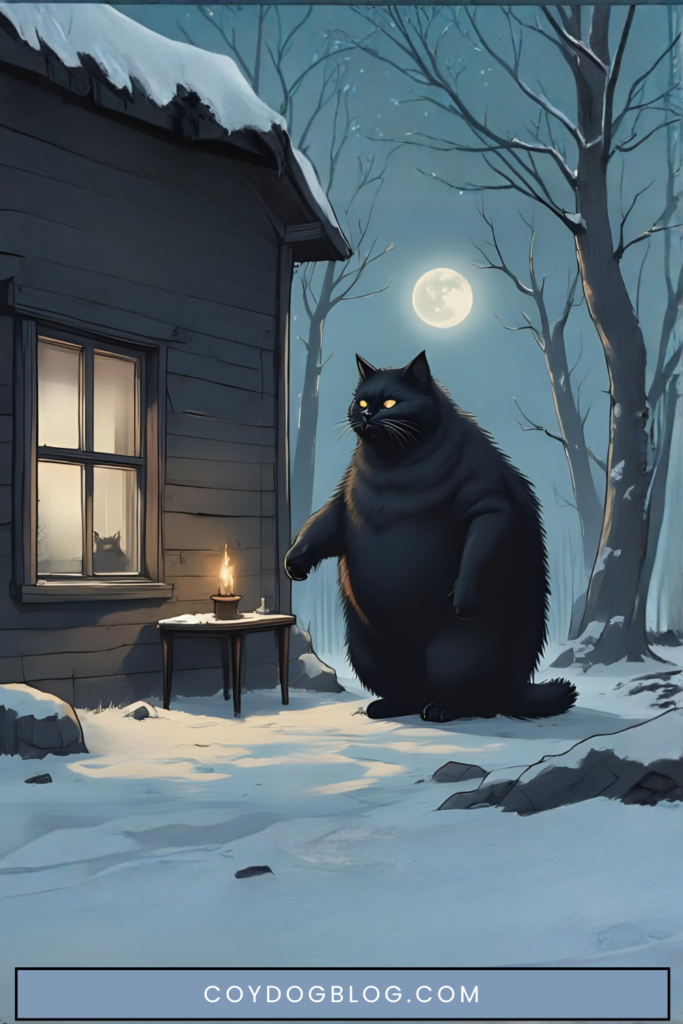
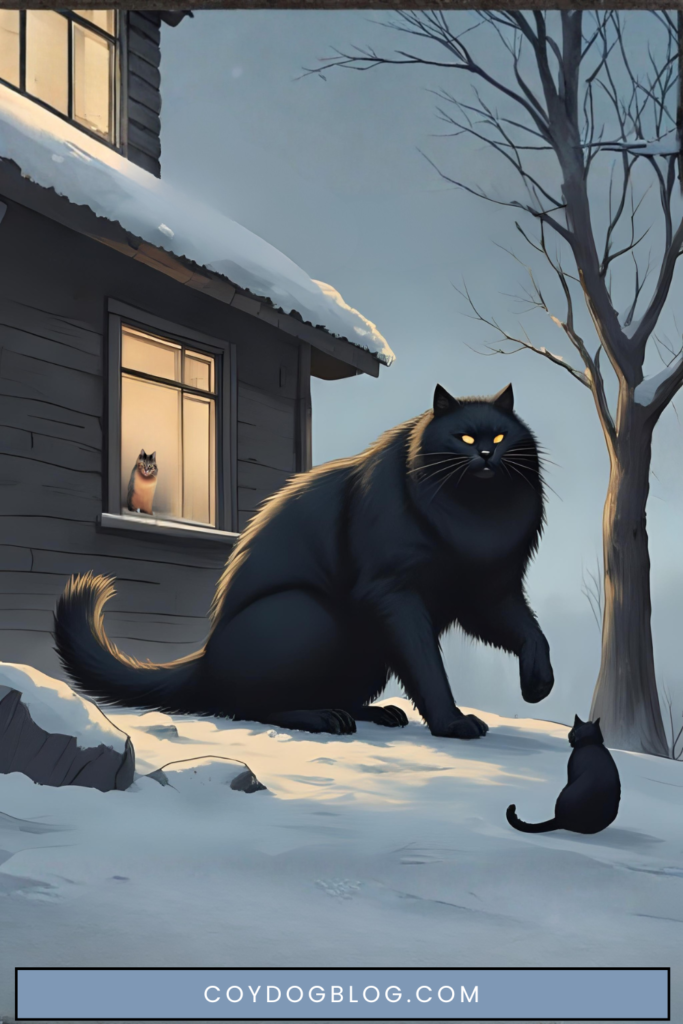
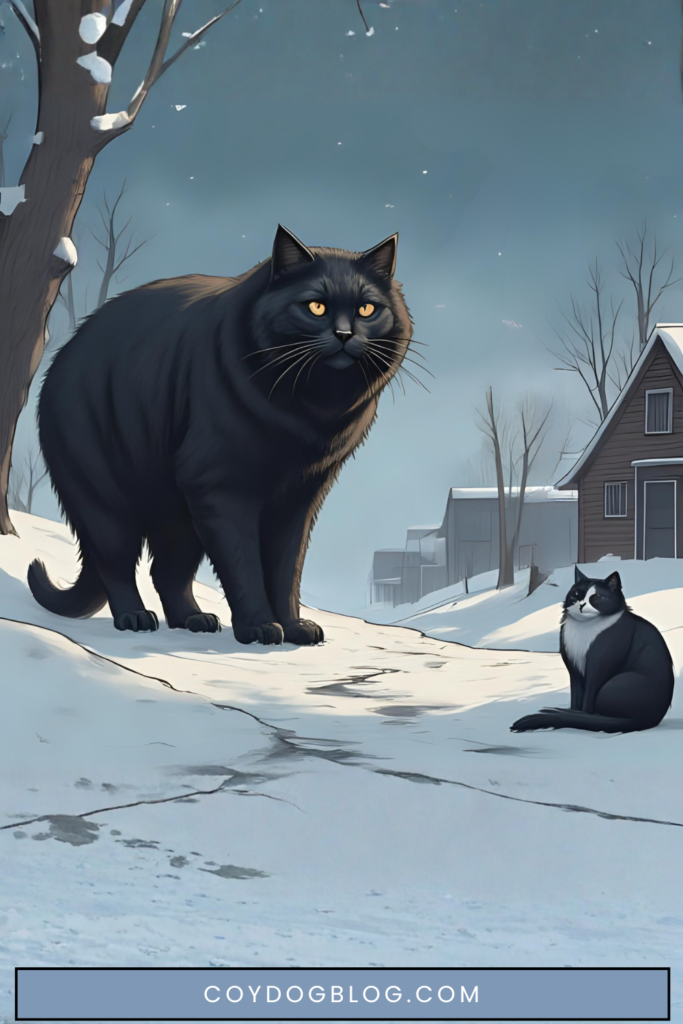
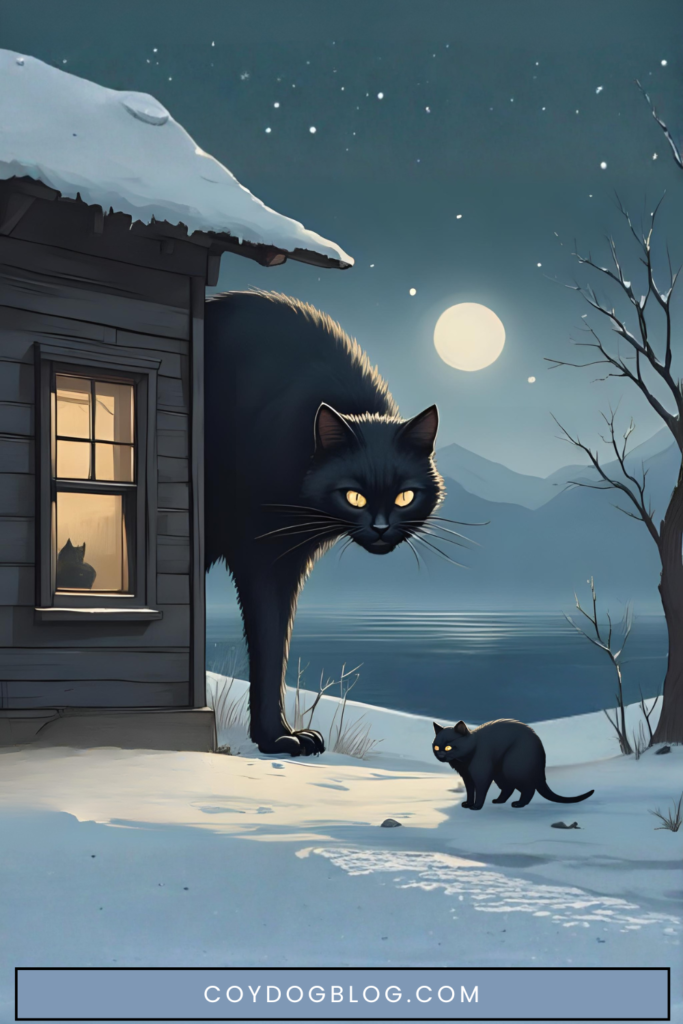
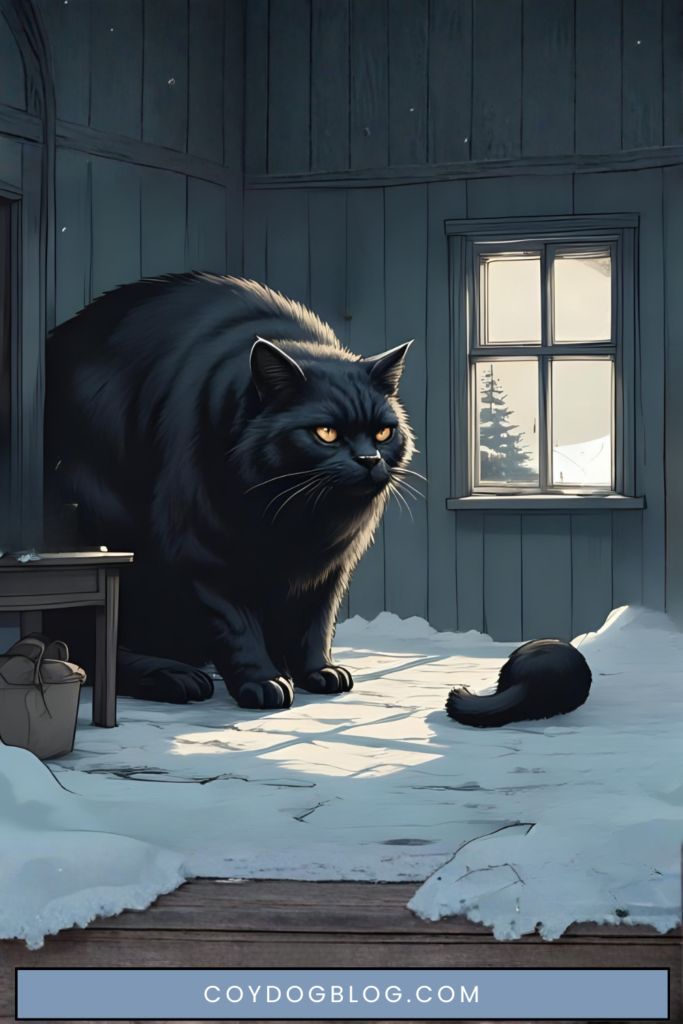
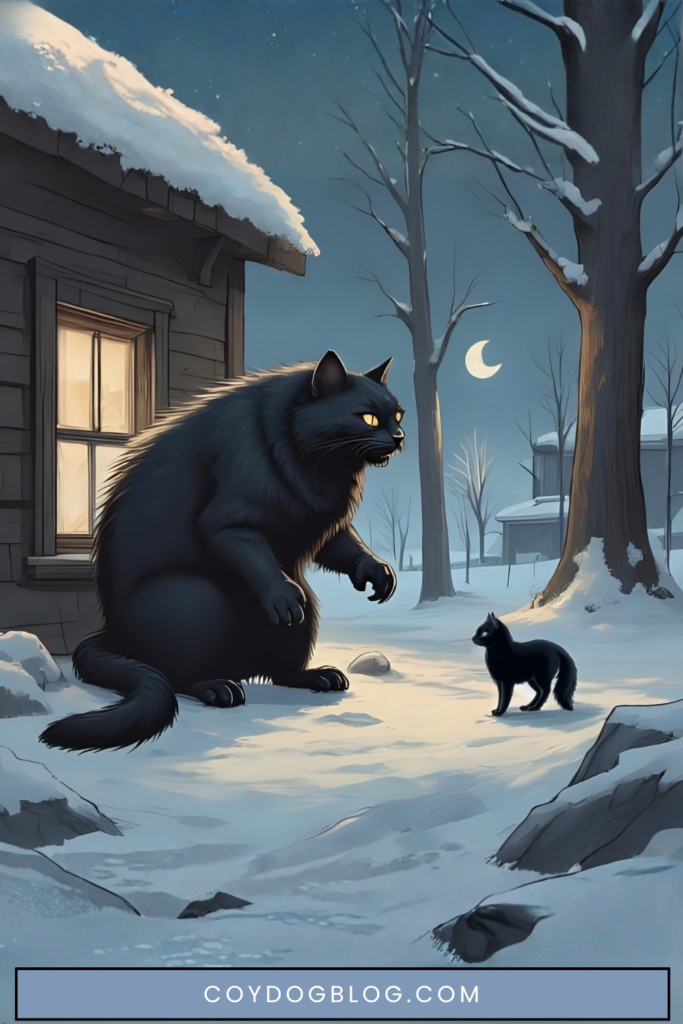
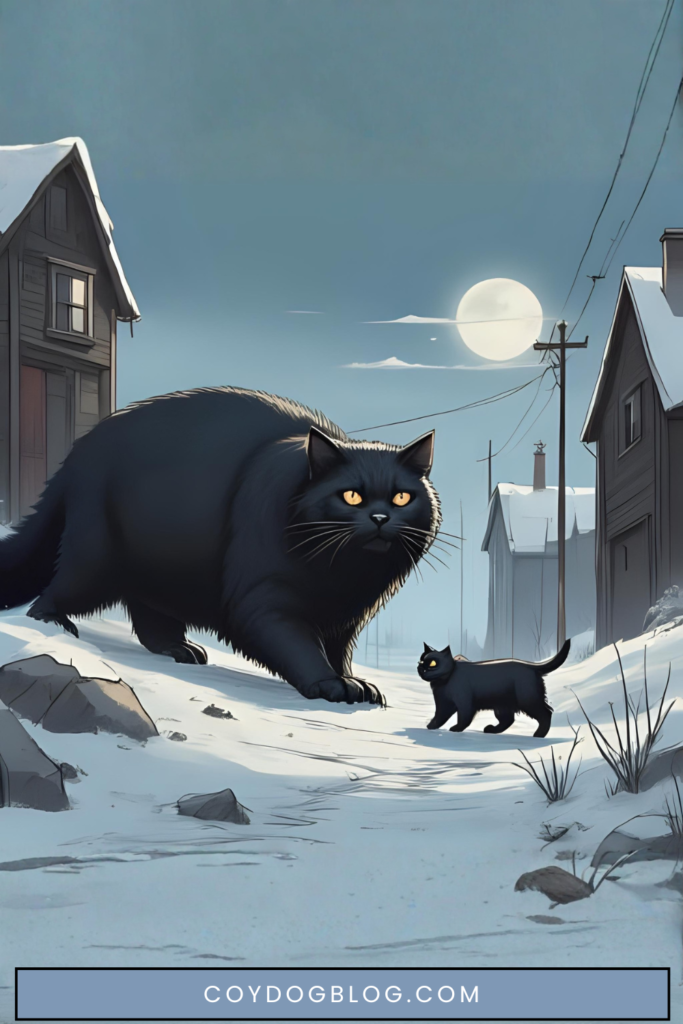
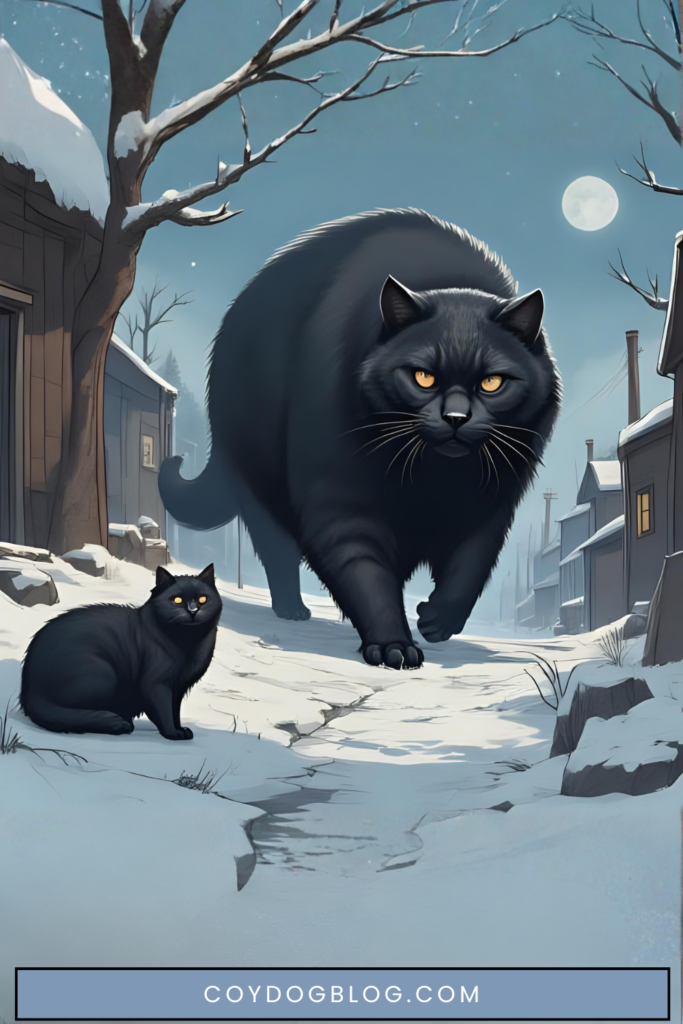
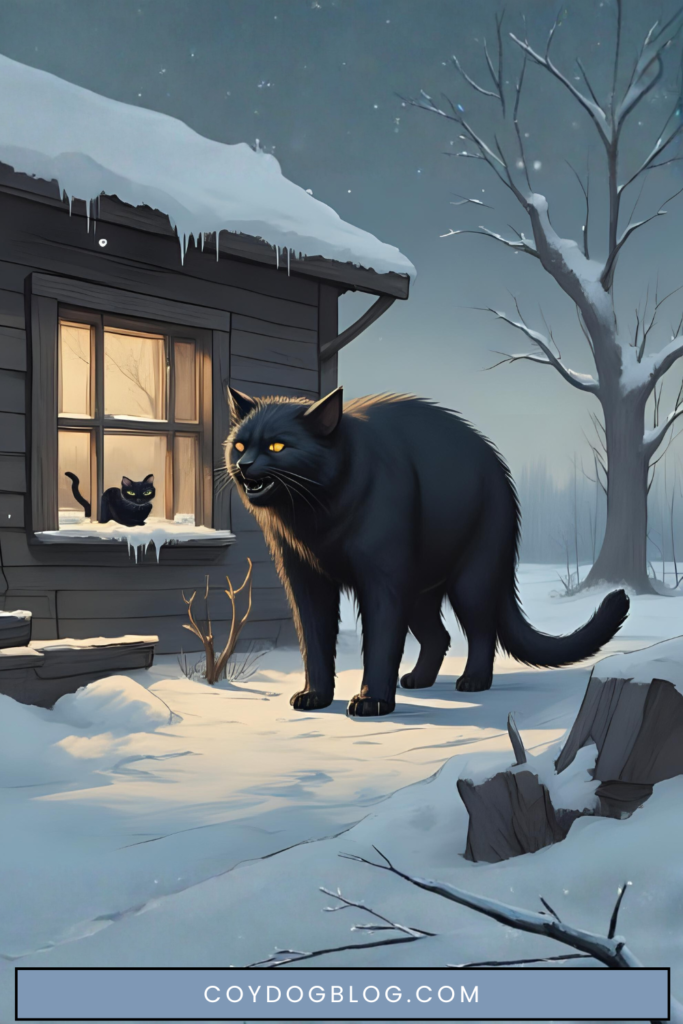
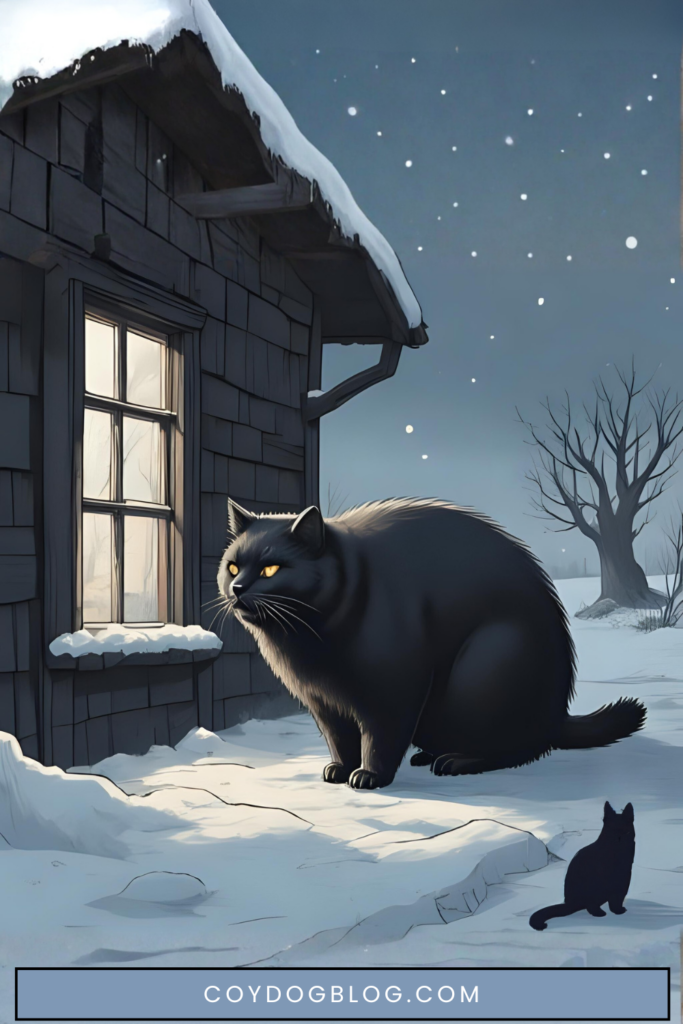
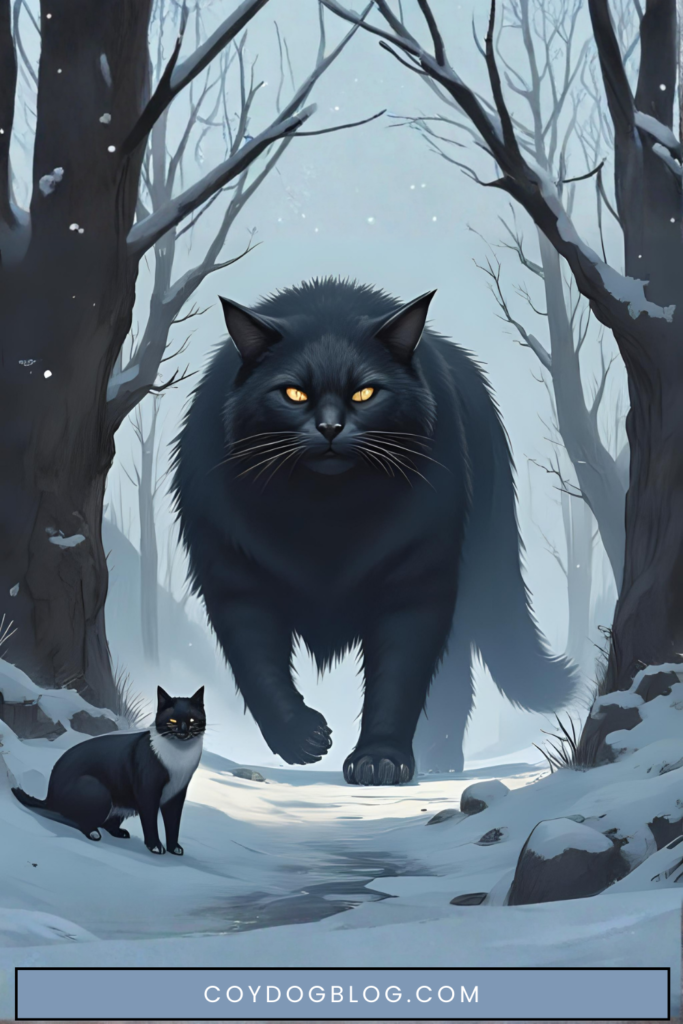
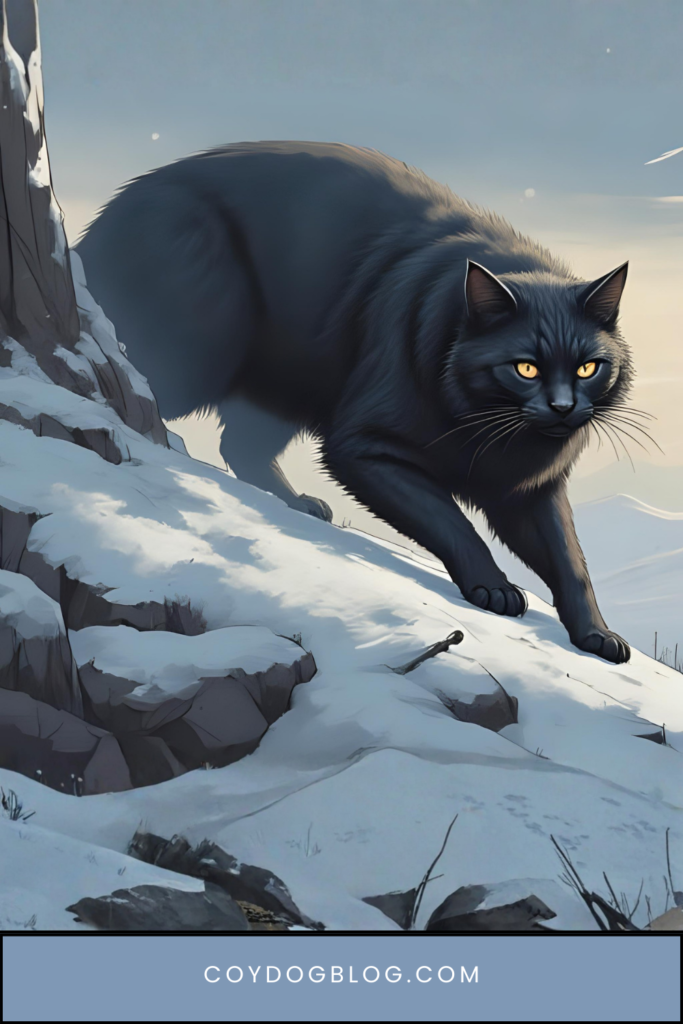
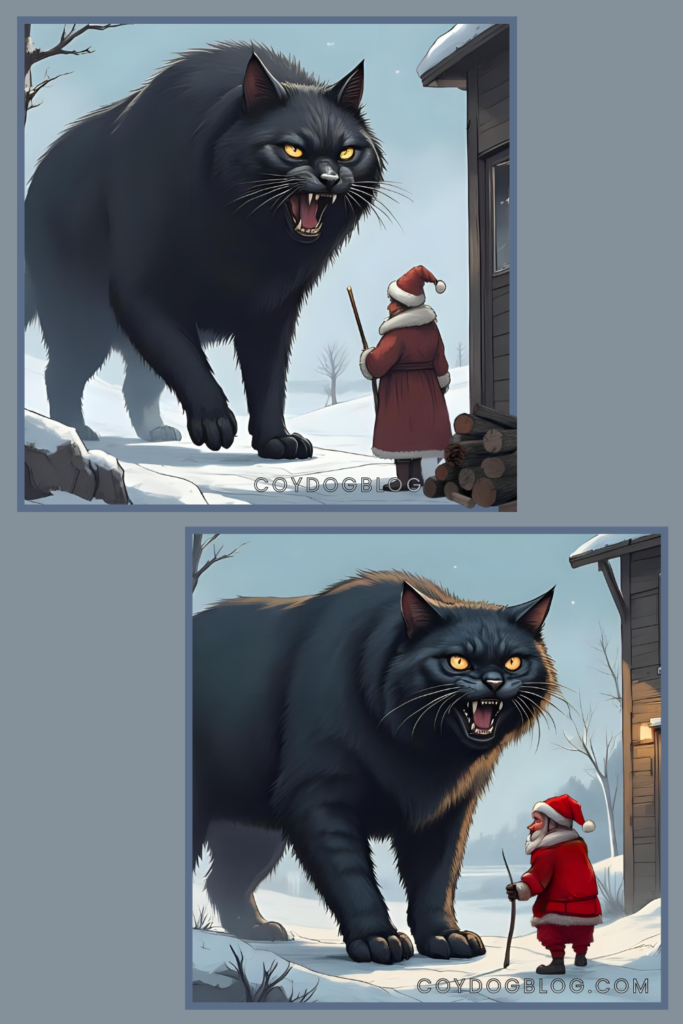
Images in this post were AI-generated (Canva). As happens when generating images, we ended up with some humorous extras. Not all made it into the post! This includes an entire series of the Yule Cat with housecats, and two with Santa Claus. All complete with caption commentary (like which ones feature 2 of our blog cats), just hover to see.
I hope you’ll enjoy these as much as I did!
 Overfull Yule Cat warms paws and chats with window cat.
- Two cats detail their people’s “crimes” to a shocked Yule Cat.
- A cheery tuxedo cat!
- It seems Yule Cat is there to back up Curious Cat while another cat loafs in the window.
- House reno by Yule Cat and black floof.
- “Tell me more.” -Yule Cat to Wise Little Cat.
- Yule Cat being joined on the prowl.
- Looks like Yule Cat is about to get this cat’s bullies.
- These two got that window open and the Yule Cat thinks it’s hillarious!
- “I don’t understand, you WANT to be in there?” -Yule Cat
- Coydog’s resident, Toes the tuxie, joins Yule Cat (no surprise here).
- Did you notice this one resembles blog cat Sixlette? Not a coincidence! This Yule Cat is black, 20-30ft tall Six! Even captured the clumsiness!
- Yule Cat seems either perturbed by what this little cat said, or about to do zoomies.
- Apparently, Santa makes Yule Cat mad! Is he not gifting enough clothes?